By Chris Stavalone
Throughout this series, we have focused on the technical and operational components of a mature security program: identifying risk, managing vulnerabilities, and enforcing secure configurations. However, even the most mature technical controls can be undermined by a single user’s action.
That is why security awareness training remains a critical component of any effective security program.
Threat actors continue to target people because human behavior is often easier to exploit than hardened infrastructure. Phishing campaigns, credential theft, business email compromise, and social engineering attacks all rely on exploiting trust, urgency, or lack of awareness.
Security awareness training reduces this risk by helping users recognize threats, respond appropriately, and understand their role in protecting organizational systems and data.
What Security Awareness Training Is (and Is Not)
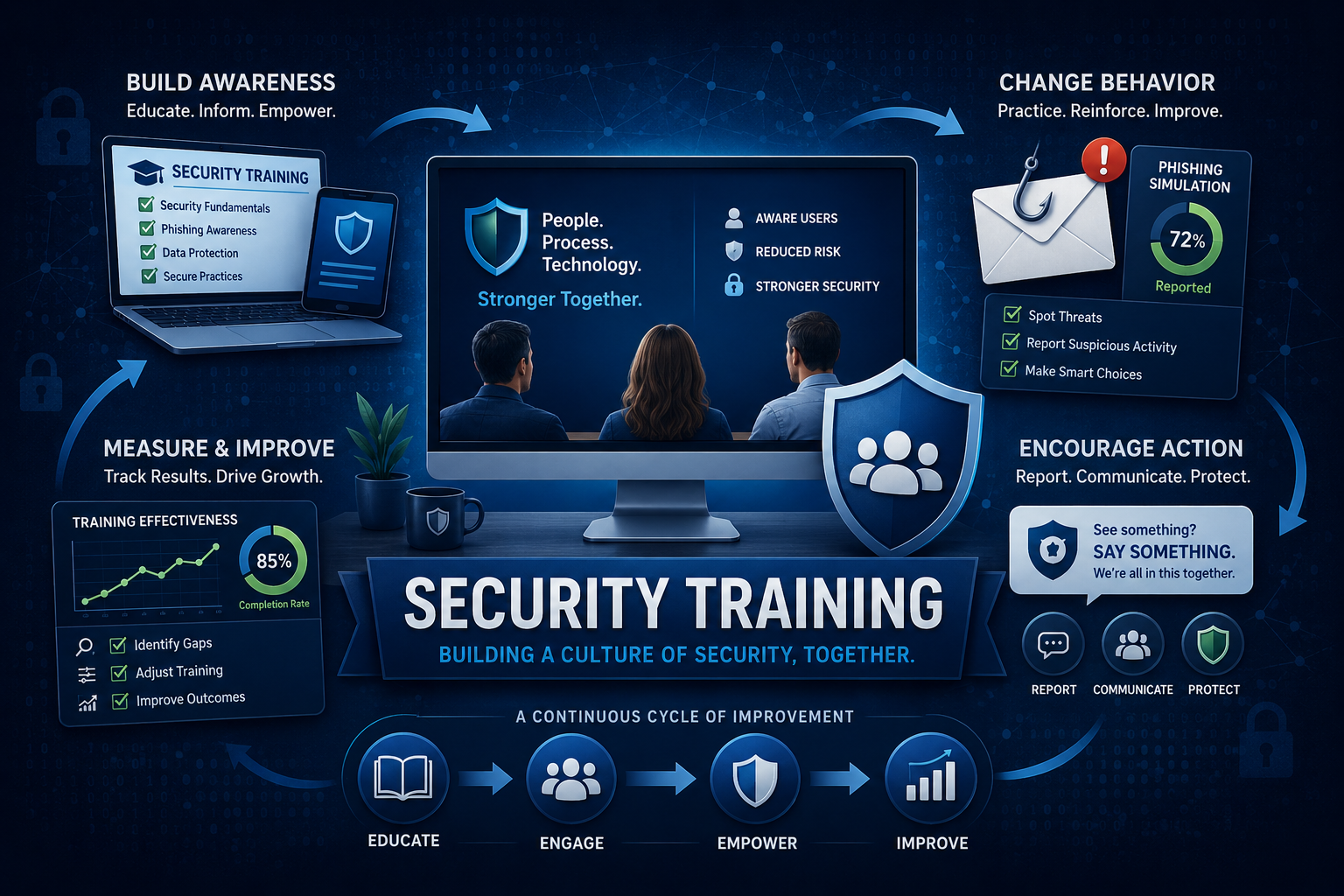
Security awareness training is an ongoing process designed to educate users on cybersecurity threats, safe practices, and organizational security expectations.
At a practical level, security awareness training answers several important questions:
- Do users understand the threats targeting the organization?
- Can employees identify phishing, social engineering, or suspicious activity?
- Do users know how and when to report security concerns?
- Is security awareness reinforced consistently over time?
Security awareness training is not:
- A once-a-year compliance video
- A checkbox exercise designed solely for audits
- Generic content disconnected from real-world threats
- A substitute for technical security controls
Like every other component discussed in this series, security awareness training must operate as a continuous process.
Why the Human Element Remains a Primary Target
Modern security technologies have significantly improved over the last decade. As a result, attackers increasingly focus on exploiting users rather than attempting direct technical compromises.
Common attack methods include:
- Phishing emails designed to harvest credentials
- Business email compromise targeting financial processes
- Malicious attachments and links
- Social engineering through phone calls or messaging platforms
These attacks are effective because they target normal human behavior: trust, curiosity, urgency, and routine.
This is why organizations cannot rely solely on technical controls. Users must be treated as part of the security architecture, not as an external variable.
The Core Components of Effective Security Awareness Training
While programs vary by organization and industry, mature security awareness programs typically include several key elements.
Foundational Security Education
Users need a clear understanding of:
- Common threat types
- Organizational security policies
- Password and authentication best practices
- Safe handling of sensitive data
Training should focus on practical scenarios users are likely to encounter in their daily work.
Phishing and Social Engineering Simulations
Simulated phishing campaigns allow organizations to measure how users respond to real-world attack scenarios. More importantly, they help reinforce behavioral learning through repetition. The goal is not to punish users for mistakes, but to build recognition and response habits over time.
Continuous Reinforcement
Security awareness cannot rely on annual training cycles alone. Threats evolve continuously, which means training should be reinforced through:
- Regular awareness campaigns
- Short-form educational content
- Simulated exercises
- Incident-driven education after emerging threats
Continuous reinforcement helps keep security awareness relevant and actionable.
Reporting and Escalation Awareness
One of the most valuable things an organization can achieve is a culture where users report suspicious activity quickly. Users should know what to report, how to report it, and why rapid reporting matters. Early reporting often determines whether an incident remains contained or becomes a larger operational disruption.
Why Security Awareness Programs Often Fail
Many organizations struggle with security awareness training because the program is treated as a compliance obligation rather than a behavioral security initiative.
Common failure points include:
- Generic training content disconnected from actual threats
- Overly technical material for non-technical users
- Infrequent or inconsistent training schedules
- Programs focused on punishment rather than improvement
When users view security training as irrelevant or purely administrative, engagement drops significantly. Effective programs focus on practicality, relevance, and consistency.
Security Awareness as Part of the Security Culture
Mature organizations integrate security awareness into the broader organizational culture.
This means that leadership visibly supports and promotes security initiatives. When security is discussed as a business responsibility, employees have a better understanding that security is part of their role. Once employees feel empowered, security awareness becomes operational behavior.
Security Awareness Training as a Risk Reduction Strategy
No organization can eliminate human error completely. The objective is to reduce the likelihood and impact of user-driven security incidents. Security awareness training supports this goal by reducing successful phishing attempts and improving incident reporting speed. Consequently, secure behavior is reinforced across departments, supporting the overall effectiveness of technical controls and ensuring that employees become an active layer of defense.
Final Thoughts
A mature security program requires more than isolated tools or reactive processes. It requires a coordinated strategy that addresses risk, vulnerabilities, configurations, and human behavior together.
Throughout this series, we explored the foundational components of a modern security program:
- Security Awareness Training
Each component strengthens the others. Together, they create a security program capable of adapting to evolving threats while supporting real business operations.
Organizations that approach security this way move beyond reactive firefighting and toward long-term operational resilience.
Author Bio
Chris is a Solutions Engineer at Stratus ip with more than seven years of experience supporting organizations across a wide range of cybersecurity initiatives. He specializes in helping clients implement secure, effective, and manageable cybersecurity solutions that align with real-world operational needs. Holding certifications including CompTIA Security+, Network+, PenTest+, and Fortinet NSE Essential Level 3, Chris brings both technical expertise and practical guidance to conversations surrounding security, networking, and risk management. He enjoys working closely with clients to bridge the gap between technical capability and business outcomes, with a focus on clarity, collaboration, and long-term security strategy. Outside of work, Chris enjoys playing music, exploring botany, and appreciating fine whiskeys.
Frequently Asked Questions About Security Awareness Training
What is security awareness training?
Security awareness training is an ongoing educational process that helps users recognize cybersecurity threats, follow secure practices, and understand their role in protecting organizational systems and data.
Why is security awareness training important?
Many modern attacks rely on social engineering and user interaction rather than direct technical exploitation. Security awareness training reduces the likelihood of successful phishing, credential theft, and other user-targeted attacks.
How often should security awareness training occur?
Many modern attacks rely on social engineering and user interaction rather than direct technical exploitation. Security awareness training reduces the likelihood of successful phishing, credential theft, and other user-targeted attacks.
Can security awareness training replace technical controls?
No. Security awareness training complements technical controls but does not replace them. Effective security programs combine user education with layered technical protections.