By Anthony Siravo
From Building a Security Program to Connecting It
In our previous series, we explored the foundational components of a mature security program, including risk assessments, vulnerability management, configuration management, and security awareness training. Each of these functions plays an important role in reducing risk, but implementing individual controls is only part of the equation.
One of the most common challenges we encounter when working with organizations is that security functions often operate independently of one another. Vulnerability management may identify critical findings, but patching priorities are determined elsewhere. Penetration test results may uncover exploitable attack paths, but those insights never influence future remediation efforts. Security awareness training generates valuable information about user risk, yet that data rarely informs broader security operations.
The result is a collection of effective tools and processes that operate in isolation rather than as part of a coordinated security strategy.
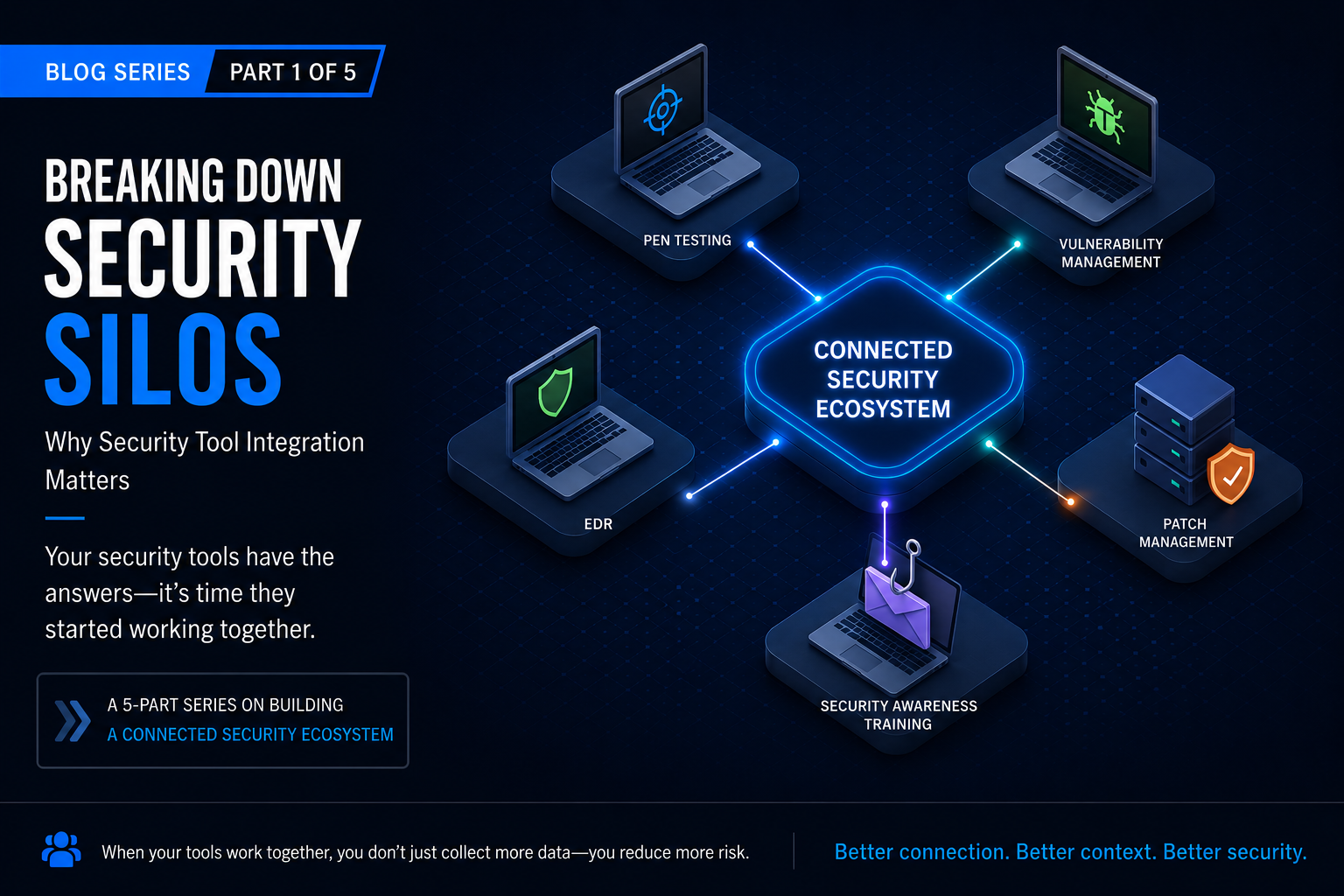
This series focuses on the next stage of security maturity: connecting the controls that already exist. A mature security program is not defined solely by the tools it deploys, but by how effectively those tools share information, influence decisions, and work together to reduce risk.
In this first post, we’ll examine why security silos continue to create unnecessary exposure and how organizations can begin building a more connected security ecosystem.
The Problem Isn’t a Lack of Security Tools
Over the last decade, organizations have invested heavily in cybersecurity technologies. Vulnerability scanners, patch management platforms, endpoint detection and response (EDR), penetration testing engagements, security awareness training platforms, and countless other tools have become standard components of modern security programs. Yet despite these investments, organizations continue to experience security incidents, ransomware attacks, data breaches, and operational disruptions.
The issue is rarely a complete lack of security controls. More often, the problem is that those controls operate independently of one another.
A vulnerability scanner identifies a critical weakness, but remediation teams are unaware of its business impact. A penetration test uncovers a viable attack path, but the findings never influence future patching priorities. An EDR platform detects suspicious activity, but nobody connects it back to the vulnerability or user behavior that enabled it.
The tools themselves are functioning as designed, but the communication between them is not.
Security Programs vs. Security Stacks
One of the most common misconceptions in cybersecurity is the belief that adding more security tools automatically improves security posture. In reality, organizations often build security stacks rather than security programs.
A security stack is simply a collection of technologies, while a security program is a coordinated system where security functions inform and reinforce one another. The distinction matters because attackers don’t operate in silos.
A successful attack rarely exploits a single weakness. Instead, attackers combine vulnerabilities, misconfigurations, compromised credentials, social engineering, and privilege escalation opportunities into a chain of events that ultimately achieves their objective. Defenders must adopt the same mindset.
Security tools should not operate independently. They should function as part of an integrated ecosystem designed to continuously identify, prioritize, remediate, monitor, and validate risk.
The Hidden Cost of Security Silos
Security silos create blind spots that are often difficult to recognize until an incident occurs.
Consider a common scenario:
- A vulnerability management platform identifies a critical vulnerability.
- The finding is added to a report.
- The report is distributed.
- Remediation is delayed due to competing priorities.
- Weeks later, the organization’s EDR platform detects exploitation attempts targeting the same system.
At every stage, individual tools performed their intended function. The failure occurred because the information generated by one control did not meaningfully influence the actions taken by another. The result is a security program that appears mature on paper but struggles to reduce risk in practice.
Why Security Tools Need Context
Security data becomes valuable when it provides context for decision-making. A vulnerability scanner may identify thousands of findings, but not all vulnerabilities carry the same level of risk.
A penetration test may identify exploitable attack paths that expose which vulnerabilities truly matter.
Patch management processes determine whether those vulnerabilities are remediated.
EDR solutions reveal whether adversaries are actively attempting to exploit them.
Security awareness training helps reduce the likelihood that users become the initial point of compromise.
Individually, each control provides information. Together, they provide intelligence. This distinction is what separates reactive security operations from mature risk management.
Building a Connected Security Ecosystem
A mature security program creates feedback loops between controls. Findings from one security function should influence decisions made elsewhere in the environment.
Examples include:
Penetration Testing → Vulnerability Management
Penetration testing validates which vulnerabilities can actually be exploited and helps prioritize remediation efforts based on real-world attack paths.
Vulnerability Management → Patch Management
Vulnerability findings should drive patching priorities rather than relying solely on standard maintenance schedules.
Patch Management → EDR
Unpatched systems and compensating controls should influence monitoring strategies and detection priorities.
Security Awareness Training → Security Operations
Phishing simulations, user behavior metrics, and reporting activity provide valuable indicators of human risk that can inform broader security decisions.
The objective is not simply to collect data, but to ensure security decisions become more informed over time.
Why This Matters for SMBs
Large enterprises often have dedicated security teams focused on individual disciplines. Small and mid-sized businesses rarely have that luxury.
IT teams are expected to manage infrastructure, support users, maintain compliance, and oversee cybersecurity simultaneously. Because resources are limited, disconnected security efforts create even greater inefficiencies. Organizations cannot afford to spend time collecting security data that never influences operational decisions. A connected security ecosystem allows SMBs to maximize the value of existing investments without continuously adding new tools.
Security Maturity Is About Integration
Many organizations measure security maturity by the number of tools they deploy. A more useful measurement is how effectively those tools work together. Mature security programs create visibility across controls, establish clear communication pathways, and ensure findings from one function drive action in another. The goal is not to build a larger security stack. The goal is to build a smarter security program.
Looking Ahead
Building a connected security program begins with understanding how individual security functions complement one another.
In the next post, we’ll explore how penetration testing and vulnerability management work together to identify not only what vulnerabilities exist, but which ones represent the greatest risk to the organization.
Author Bio
Anthony Siravo is a Solution Engineer with over 15 years of experience in cybersecurity, working with organizations across a wide range of industries and environments. With Network+, Security+, and PenTest+ certifications, Anthony specializes in translating complex security concepts into practical, risk-driven programs that align with real-world business operations. Since entering the field in 2008, Anthony has focused on helping IT leaders move beyond reactive security and toward sustainable, measurable risk management.