By Diamante Cherry
Why Risk Assessment is the Starting Point of Any Security Program
In the previous post, we established that a security program is not defined by tools or compliance checklists, but by a structured, risk-driven approach to protecting the business. Risk assessment is where that approach begins.
From a practical standpoint, a security program without a formal risk assessment process is operating on assumptions. Decisions about controls, tooling, staffing, and spending are made without a clear understanding of what actually threatens the organization or what the real business impact would be if controls fail. Over time, this leads to misaligned investments, control gaps in critical areas, and excessive effort spent protecting low-value assets.
Risk assessment provides a factual basis for every other component of the security program. It establishes context, prioritization, and defensibility, which are three things executive leadership expects from modern security teams.
What a Risk Assessment Actually Is (and Is Not)
A risk assessment is a structured process used to identify and evaluate:
- Business-critical assets
- Credible threat scenarios
- Existing vulnerabilities and control gaps
- The likelihood and impact of adverse events
The outcome is not a theoretical risk score or a compliance artifact. The outcome is decision support.
What risk assessment is not:
- A vulnerability scan
- A penetration test
- A one-time compliance exercise
- A static document that lives in a shared drive
Those activities can inform a risk assessment, but they do not replace it. Mature organizations understand that risk assessment is a management process, not a technical output.
Risk Is a Business Problem, Not a Technical One
One of the most important shifts security leaders must make is reframing risk in business terms. While risk is discovered through technical analysis, it must be evaluated and communicated in a way that aligns with how the organization operates.
Effective risk assessments answer questions such as:
- What business processes would be disrupted by this event?
- What data would be exposed, altered, or unavailable?
- What regulatory, legal, or contractual obligations would be triggered?
- What is the operational and financial impact of downtime?
When risk is expressed solely in terms of CVSS scores, exploitability, or tool-generated severity ratings, it fails to resonate with executive leadership. Risk assessments bridge the gap between technical findings and business impact.
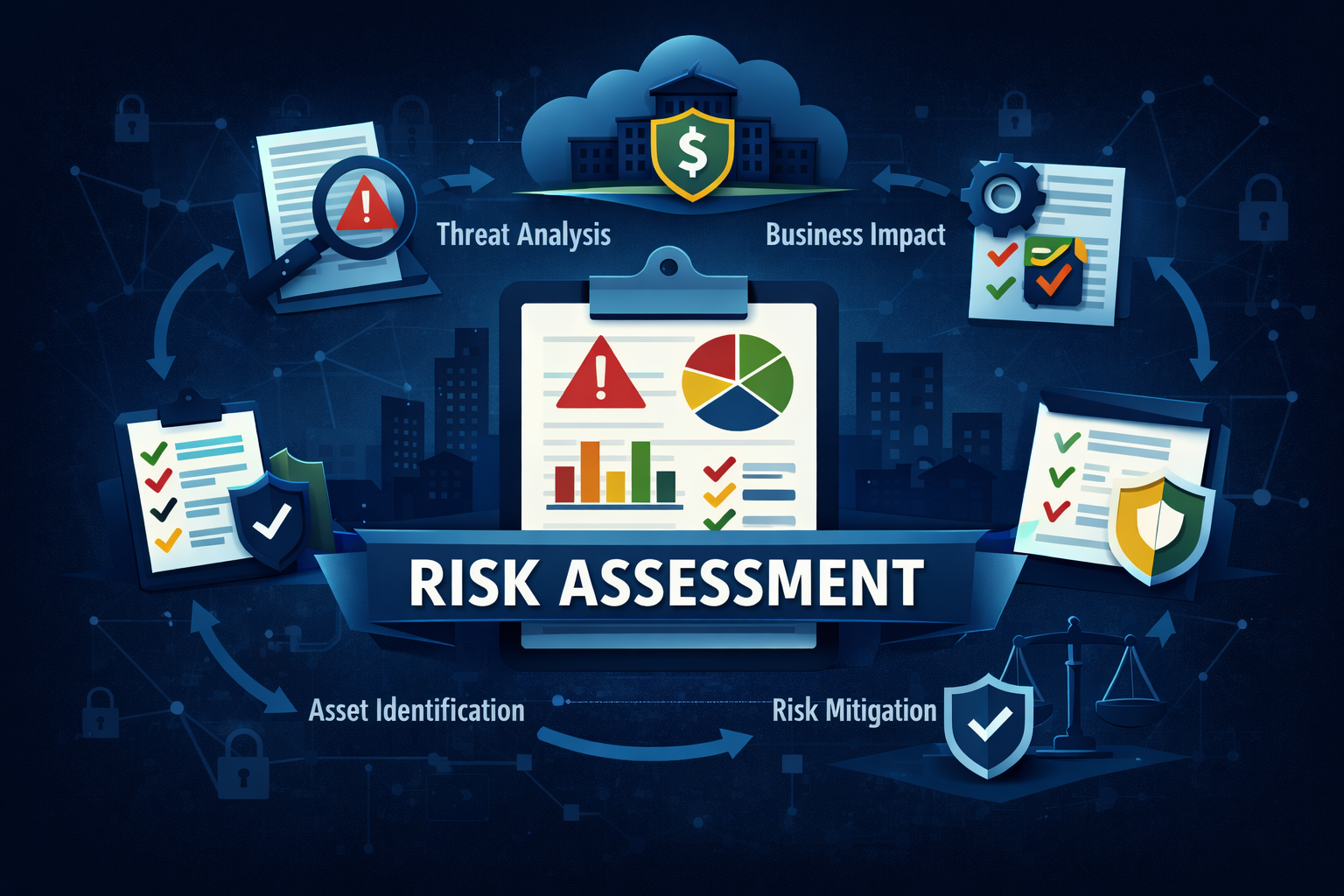
Core Components of a Practical Risk Assessment
While methodologies vary across industries and frameworks, effective risk assessments consistently include the following elements:
Asset Identification and Classification
You cannot assess risk without knowing what you are protecting. This includes systems, data, applications, users, and supporting infrastructure.
Asset classification should reflect business criticality, not just technical importance. A system that supports revenue generation or regulatory obligations carries inherently more risk than one that does not.
Threat Modeling
Threat modeling identifies how assets could realistically be compromised. This includes external threats, insider misuse, third-party exposure, and environmental factors.
The goal is not to catalog every hypothetical threat, but to focus on credible scenarios that align with the organization’s industry, size, and operating model.
Vulnerability and Control Evaluation
This step evaluates how existing controls reduce—or fail to reduce—identified threats. Vulnerabilities may be technical, procedural, or organizational.
At this stage, organizations often discover that control coverage is uneven: some low-risk areas are over-controlled, while high-risk areas rely on informal or inconsistent processes.
Impact and Likelihood Analysis
Risk is ultimately a function of likelihood and impact. While precise quantification is often unrealistic, structured estimation is both achievable and valuable.
This analysis enables prioritization. Not all risks require immediate remediation, but all material risks should be understood, owned, and tracked.
How Risk Assessments Drive the Rest of the Security Program
A properly executed risk assessment directly informs every downstream security activity:
- Vulnerability management: Determines which findings matter most and why
- Configuration management: Guides where baseline enforcement is most critical
- Security awareness training: Focuses user education on relevant threat scenarios
- Governance and metrics: Establishes risk-based KPIs that leadership can track
Without risk assessment, these functions operate in isolation. With it, they operate as a coordinated system.
Common Failure Modes to Avoid
Organizations new to formal risk assessment often encounter the same issues:
- Treating risk assessment as a one-time project
- Over-engineering scoring models that obscure decision-making
- Failing to update assessments as the environment changes
- Producing reports that are technically accurate but operationally unusable
Risk assessments should evolve with the business. Changes in infrastructure, vendors, threat activity, or regulatory exposure should trigger reassessment.
Risk Assessment as a Continuous Discipline
Mature security programs treat risk assessment as an ongoing discipline rather than a periodic task. This does not mean constant re-analysis, it means integrating risk thinking into change management, architecture decisions, and incident response planning.
For SMBs in particular, this approach enables right-sized security. Limited resources are directed where they reduce the most risk, rather than being spread evenly across the environment.
Looking Ahead
Risk assessment defines what matters and why. In the next post in this series, we’ll examine vulnerability management and how organizations can translate risk insight into effective remediation and measurable risk reduction.
Author Bio
Diamante is a Solutions Engineer at Stratus ip with a strong foundation in hands-on cybersecurity and risk-driven security practices. She attended the University of Pennsylvania’s Cybersecurity Bootcamp, where she developed practical skills in threat analysis, security labs, and technical reporting, and went on to earn her CompTIA Security+ certification. In 2025, Diamante joined Stratus ip as a Solutions Engineer, working closely with organizations to support effective security programs. She later earned her CompTIA PenTest+ certification to further strengthen her ability to assess vulnerabilities, evaluate threat exposure, and translate technical findings into actionable security improvements for IT leaders.
Frequently Asked Questions (FAQs) About Risk Assessments
What is a cybersecurity risk assessment?
A cybersecurity risk assessment is a structured process used to identify critical assets, evaluate credible threat scenarios, analyze existing controls, and determine the potential business impact of security failures. Its purpose is to support informed risk-based decision-making, not to generate a compliance artifact.
How often should an organization perform a risk assessment?
At a minimum, organizations should perform a formal risk assessment annually. However, material changes such as new systems, cloud migrations, mergers, regulatory changes, or significant threat activity should trigger an updated assessment.
Is a risk assessment the same as a vulnerability scan or penetration test?
No. Vulnerability scans and penetration tests identify technical weaknesses. A risk assessment evaluates how those weaknesses, combined with threats and business context, translate into actual organizational risk.
Do small and mid-sized businesses need formal risk assessments?
Yes. SMBs often have fewer resources and therefore less margin for error. A right-sized risk assessment helps SMBs focus limited security investment on the areas that reduce the most business risk.