By Diamante Cherry
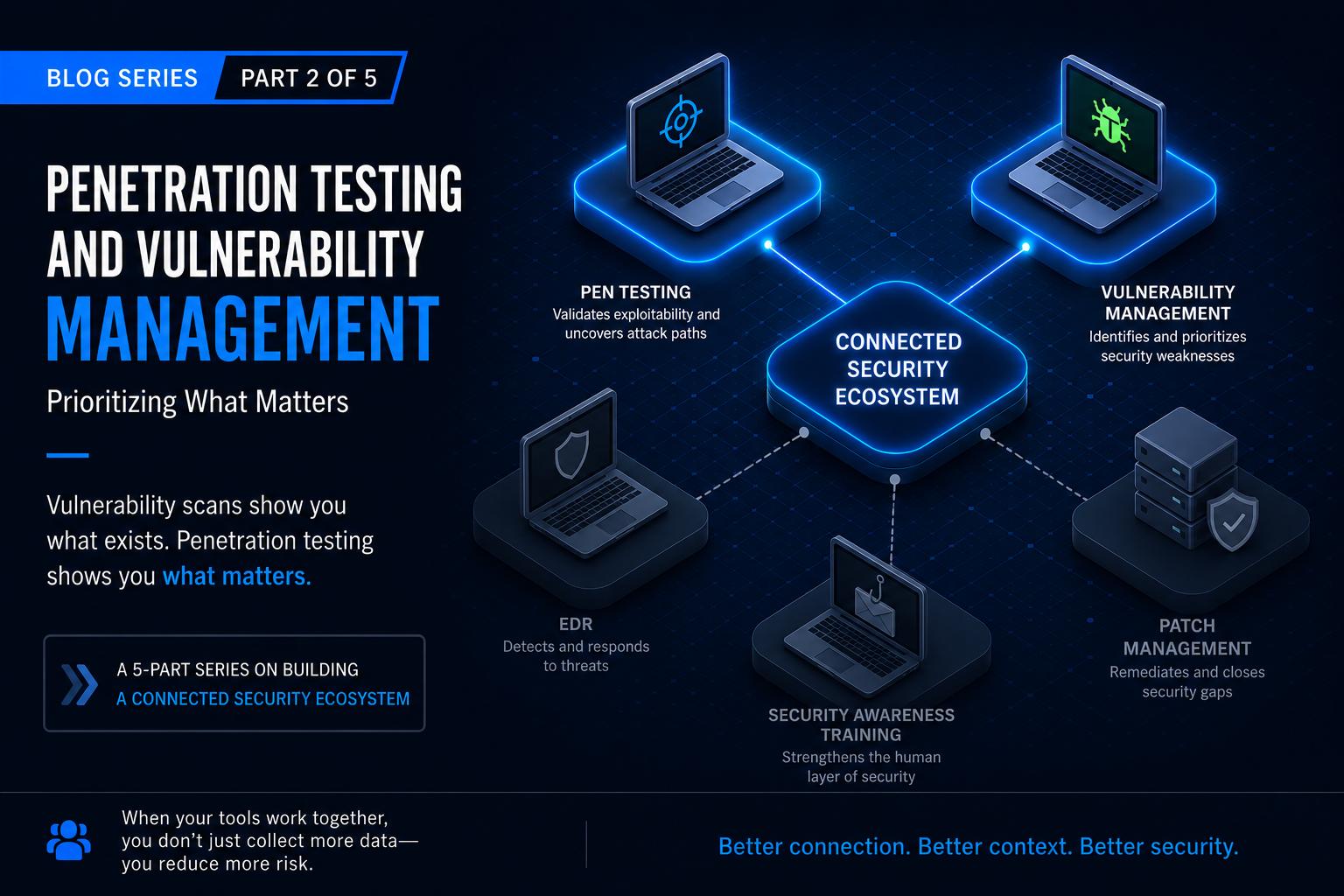
In the first post of this series, we discussed why security tools are most effective when they work together rather than in isolation. A mature security program isn’t defined by the number of tools an organization owns, it’s defined by how effectively those tools share information to reduce risk.
One of the most valuable relationships within a connected security ecosystem is between penetration testing and vulnerability management.
Both identify security weaknesses, but they answer very different questions. Understanding how they complement each other allows organizations to move beyond simply finding vulnerabilities and begin prioritizing the ones that present the greatest business risk.
Different Objectives, Different Value
Although they’re often grouped together, penetration testing and vulnerability management serve distinct purposes.
A vulnerability management program is designed to continuously identify, assess, prioritize, and track known security weaknesses across systems and applications. It provides ongoing visibility into the organization’s attack surface and helps teams understand where vulnerabilities exist.
A penetration test, on the other hand, answers a different question:
Can those vulnerabilities actually be exploited?
Instead of cataloging weaknesses, penetration testing simulates the techniques an attacker would use to determine whether seemingly unrelated findings can be chained together to compromise systems, escalate privileges, or gain access to sensitive information.
The difference is significant: one tool identifies exposure, while the other validates risk.
Why Severity Scores Don’t Tell the Whole Story
Many organizations rely heavily on vulnerability severity ratings such as CVSS to prioritize remediation.
Severity scores are valuable, but they represent only one piece of the equation.
Consider two vulnerabilities:
- A Critical vulnerability on an isolated internal test server
- A Medium vulnerability on an internet-facing application that provides a path to domain administrator privileges
Which should be addressed first?
Without context, most organizations would choose the Critical vulnerability.
A penetration test often reveals that the Medium vulnerability represents substantially greater organizational risk because it can actually be leveraged within a broader attack path.
Risk is determined by context, not simply by severity.
Penetration Testing Adds Context to Vulnerability Data
One of the greatest strengths of penetration testing is its ability to validate which findings are truly exploitable.
Rather than reviewing vulnerabilities individually, penetration testers evaluate how attackers think.
They ask questions like:
- Can these vulnerabilities be chained together?
- Does this misconfiguration create an unexpected attack path?
- Can compromised credentials lead to privilege escalation?
- How far could an attacker move if this system were breached?
These answers help organizations distinguish between theoretical risk and operational risk.
Instead of treating every vulnerability equally, security teams gain the context needed to focus resources where they will have the greatest impact.
A Practical Example
Imagine a vulnerability scan identifies:
- An outdated web application
- Weak Active Directory permissions
- A missing operating system patch
Viewed independently, each finding appears manageable.
During a penetration test, however, the tester discovers that the outdated application allows initial access. Weak Active Directory permissions enable privilege escalation, and the missing patch allows lateral movement across the environment.
Individually, the findings seem routine.
Together, they represent a viable attack path that could result in complete domain compromise.
This is why penetration testing should inform vulnerability management—not replace it.
Making Vulnerability Management Smarter
When penetration testing results are incorporated into vulnerability management, remediation becomes significantly more effective.
Instead of asking:
“Which vulnerabilities have the highest CVSS score?”
Organizations begin asking:
“Which vulnerabilities contribute to the greatest business risk?”
This shift allows security teams to:
- Prioritize exploitable vulnerabilities over theoretical ones
- Reduce alert fatigue
- Focus remediation resources more effectively
- Improve communication with executive leadership by tying technical findings to business impact
The result is a vulnerability management program that becomes increasingly risk-driven rather than checklist-driven.
Common Mistakes Organizations Make
Organizations often struggle to maximize the value of these two functions because they operate independently.
Common challenges include:
- Treating penetration testing as an annual compliance exercise
- Using vulnerability scans solely to satisfy audit requirements
- Prioritizing remediation exclusively by severity scores
- Failing to incorporate penetration testing findings into ongoing vulnerability management
When these activities remain disconnected, valuable intelligence is lost.
A Connected Approach
In a mature security program, penetration testing and vulnerability management continuously strengthen one another.
Vulnerability management provides ongoing visibility into known weaknesses.
Penetration testing validates which of those weaknesses are most likely to be exploited.
Those insights then feed back into remediation priorities, improving the effectiveness of the entire vulnerability management process.
This continuous feedback loop is what transforms individual security activities into a connected security ecosystem.
Understanding which vulnerabilities matter is only the first step. Organizations must also ensure those risks are remediated efficiently.
In the next post, we’ll explore how vulnerability management and patch management work together to close the remediation gap and reduce organizational risk more effectively.
Author Bio
Diamante is a Solutions Engineer at Stratus ip with a strong foundation in hands-on cybersecurity and risk-driven security practices. She attended the University of Pennsylvania’s Cybersecurity Bootcamp, where she developed practical skills in threat analysis, security labs, and technical reporting, and went on to earn her CompTIA Security+ certification. In 2025, Diamante joined Stratus ip as a Solutions Engineer, working closely with organizations to support effective security programs. She later earned her CompTIA PenTest+ certification to further strengthen her ability to assess vulnerabilities, evaluate threat exposure, and translate technical findings into actionable security improvements for IT leaders.