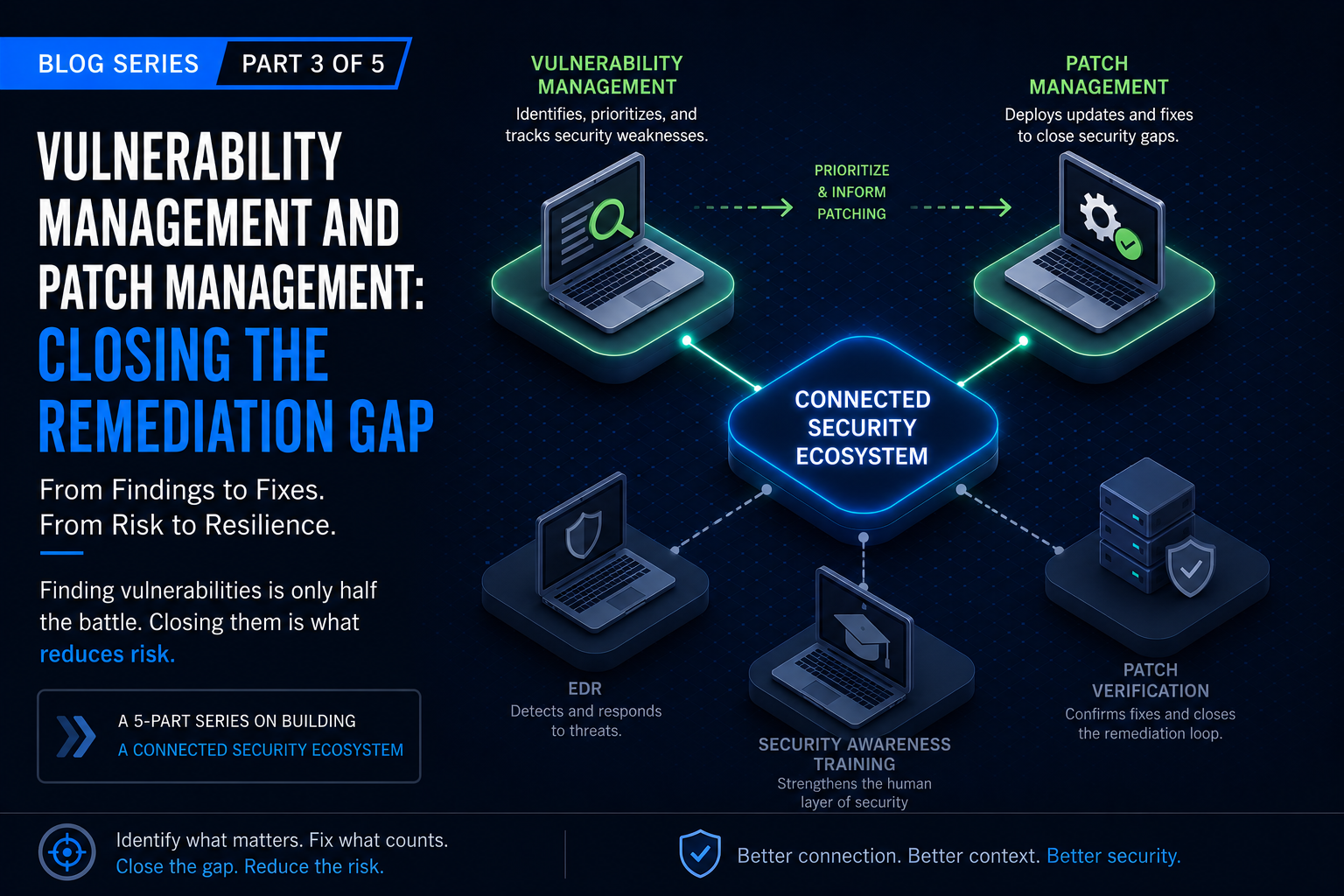
Vulnerability Management and Patch Management Are Not the Same Thing.
Vulnerability management and patch management are closely related, but they serve different functions. Vulnerability management continuously identifies, evaluates, prioritizes, and tracks weaknesses across the environment. Patch management focuses on deploying software and operating system updates that correct known vulnerabilities, bugs, and other issues. Put simply: Vulnerability management identifies and prioritizes risk. Patch management helps remove it. This distinction is important because a vulnerability management platform can generate thousands of findings, but those findings only become meaningful when there is an operational process for addressing them. The vulnerability management process should therefore inform the patch management process, not exist beside it.The Problem With Patching by Schedule Alone
Most IT teams already have some form of patching cadence. Systems may be updated weekly, monthly, or during predetermined maintenance windows. For routine maintenance, that structure makes sense. From a security perspective, however, not every vulnerability can wait for the next scheduled patch cycle. Consider two systems scheduled to receive updates at the end of the month. One contains a vulnerability with no known exploitation and limited exposure. The other contains a vulnerability that is actively being exploited, is present on an internet-facing asset, and could provide access to sensitive systems. Treating both systems according to the same schedule ignores the context provided by vulnerability management. A mature process allows risk to influence remediation urgency. Patch schedules still matter, but they should not be the only factor determining when a security weakness gets addressed.Prioritization Has to Survive the Hand-Off
This is where security silos often become apparent. The vulnerability management team may spend significant time identifying and prioritizing the most important findings. But when that information reaches the team responsible for patching, the context can disappear. Instead of receiving: “This vulnerability is actively exploitable on an internet-facing production server supporting a critical business process.” The patching team may simply receive: “Critical vulnerability. Patch available.” Technically, the information is correct. Operationally, much of its value has been lost. Effective integration requires vulnerability context to follow the finding through remediation. That can include:- Vulnerability severity
- Known or active exploitation
- Asset criticality
- Internet exposure
- Availability of a vendor patch
- Business impact
- Results from penetration testing
- Required remediation timeframe
Not Every Vulnerability Has a Patch
Connecting vulnerability and patch management also makes an important limitation clear: patching cannot solve every vulnerability. A vulnerability may:- Not yet have a vendor patch available
- Exist on a legacy system that cannot be updated
- Require an application version that creates compatibility issues
- Affect a business-critical system that cannot immediately tolerate downtime
- Stem from a configuration issue rather than outdated software
- Network segmentation
- Access restrictions
- Configuration changes
- Increased monitoring
- Application controls
- EDR-based detection or prevention
Remediation Isn’t Complete Until You Verify It
Another common disconnect occurs after a patch is deployed. A patch management platform may report that an update was successfully installed. That does not necessarily mean the underlying vulnerability is gone. Updates can fail, systems can fall outside deployment groups, devices can remain offline during patch windows. A patch may install successfully but require additional configuration or a restart before the vulnerability is fully remediated. This is why the relationship between vulnerability and patch management should operate as a closed feedback loop: Identify → Prioritize → Patch → Verify → Reassess After remediation, vulnerability management should validate that the original exposure no longer exists. If it does, the issue returns to the remediation workflow. That verification step turns patch deployment into measurable risk reduction.Better Metrics Start With Better Integration
When vulnerability and patch management are disconnected, organizations often measure each process separately. The vulnerability team reports:- Number of vulnerabilities discovered
- Critical and high-severity findings
- Vulnerability trends
- Patch deployment rates
- Patch success rates
- Systems updated
- Mean time to remediate
- Percentage of critical vulnerabilities remediated within SLA
- Number of exploitable vulnerabilities remaining
- Recurring vulnerabilities
- Vulnerabilities reopened after failed remediation
- Risk reduction over time
The Goal Isn’t More Findings. It’s Fewer Open Risks.
Vulnerability management tools are exceptionally good at generating data. That can become a problem when organizations mistake visibility for progress. A report containing 5,000 vulnerabilities may demonstrate that the scanning technology is working. It does not demonstrate that the security program is improving. The real value of vulnerability management comes from what happens after the finding is generated. When vulnerability management informs patch priorities, patching removes the underlying weakness, and vulnerability management verifies remediation, the two functions create a continuous cycle of improvement. That is what connected security operations should look like.Looking Ahead
Penetration testing helps validate what matters. Vulnerability management turns those insights into prioritized findings. Patch management begins closing the identified gaps. But no organization can patch every weakness immediately, and some threats will bypass preventative controls entirely. That makes visibility into what is actually happening on endpoints essential. In the next post in the Breaking Down Security Silos series, we’ll explore how patch management and EDR work together to manage remaining exposure, detect malicious activity, and provide another layer of protection when prevention alone isn’t enough.Author Bio
Trevor is a Senior Solutions Engineer focused on helping organizations identify and reduce technical risk across modern IT environments. With certifications including CompTIA Network+, Security+, PenTest+, and CASP+, he brings a strong foundation in network security, vulnerability assessment, and threat analysis. Trevor works closely with organizations to strengthen their security posture through practical vulnerability management and risk-driven security practices.Frequently Asked Questions
What is the difference between vulnerability management and patch management?
Vulnerability management identifies, evaluates, prioritizes, and tracks security weaknesses across an environment. Patch management deploys software and operating system updates that remediate many of those weaknesses. Vulnerability management determines what needs attention, while patch management is one mechanism used to address it.
How should vulnerability management influence patch management?
Vulnerability data should help determine patching priorities based on factors such as exploitability, asset criticality, internet exposure, business impact, and threat activity rather than relying solely on a predetermined patch schedule.
Does patching eliminate every vulnerability?
No. Some vulnerabilities do not have available patches, while others result from configuration issues or affect systems that cannot immediately be updated. Organizations may need compensating controls to reduce risk until permanent remediation is possible.
How can organizations verify that a patch fixed a vulnerability?
Systems should be rescanned or otherwise validated after remediation. This confirms that the vulnerability is no longer present rather than relying solely on a successful patch deployment status.
What vulnerability and patch management metrics should IT leaders track?
Useful metrics include mean time to remediate, remediation SLA performance, critical and exploitable vulnerabilities remaining, failed remediation attempts, recurring vulnerabilities, and overall changes in organizational exposure.