By Trevor Talkowski
Why Vulnerability Management Matters in a Security Program
In the previous post in this series, we discussed how risk assessments establish the foundation of an effective security program by identifying what matters most to the organization and why. Once that risk context exists, the next challenge becomes operational: how do organizations actually reduce the risk that has been identified?
This is where vulnerability management becomes essential.
Vulnerability management is the operational engine of a security program. It transforms risk insight into concrete action by identifying weaknesses across systems, applications, and infrastructure and ensuring they are prioritized and remediated in a structured way. Without a disciplined vulnerability management process, even well-understood risks remain unresolved.
Organizations frequently invest in scanning tools, patching systems, and security monitoring platforms. However, tools alone do not constitute vulnerability management. The true objective is not to collect vulnerability data, it’s to systematically reduce exposure to real-world threats.
What Vulnerability Management Is (and Is Not)
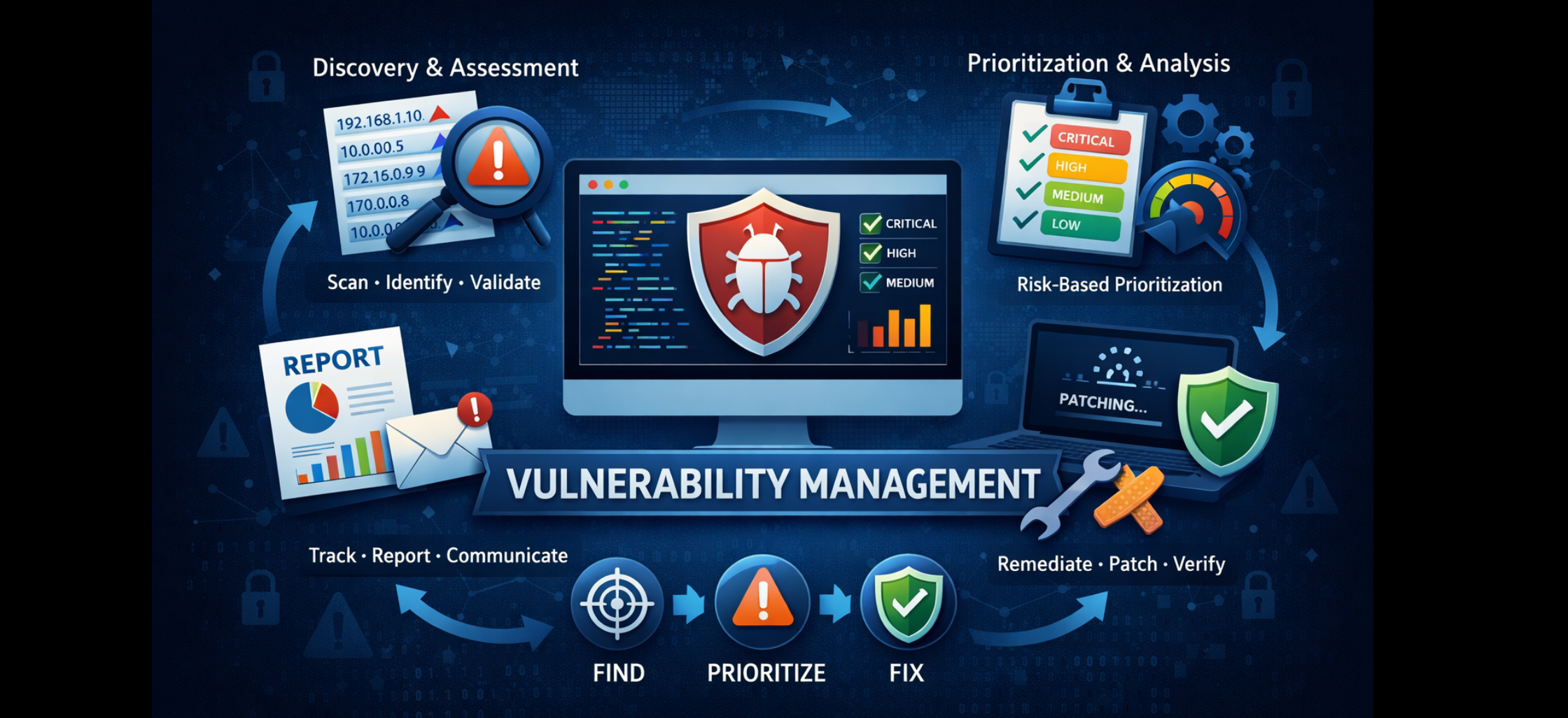
Vulnerability management is a continuous process for identifying, evaluating, prioritizing, and remediating security weaknesses across the technology environment.
At a practical level, vulnerability management answers several key questions:
- What vulnerabilities exist across our systems and applications?
- Which of these weaknesses are actually exploitable in our environment?
- Which vulnerabilities represent the greatest business risk?
- How quickly are we able to remediate them?
It is important to distinguish vulnerability management from related—but separate—security activities.
Vulnerability management is not:
- A single vulnerability scan
- A penetration test performed once per year
- A patching process without prioritization
- A report generated for compliance purposes
Those activities may contribute useful information, but vulnerability management is ultimately a continuous operational discipline designed to reduce risk over time.
The Core Components of an Effective Vulnerability Management Program
While methodologies vary, mature organizations typically implement vulnerability management through several consistent stages.
Asset Visibility
Before vulnerabilities can be identified, organizations must understand what assets exist in the environment. This includes endpoints, servers, cloud resources, applications, network infrastructure, and supporting services.
Incomplete asset visibility is one of the most common reasons vulnerability management programs fail. Systems that are not inventoried are rarely scanned, monitored, or patched consistently.
Vulnerability Identification
Once assets are known, organizations can begin identifying vulnerabilities through automated scanning, configuration analysis, vendor advisories, and threat intelligence.
Effective programs rely on multiple data sources to maintain accurate visibility into newly discovered weaknesses across operating systems, applications, and third-party software.
Risk-Based Prioritization
Not all vulnerabilities pose equal risk.
Many organizations initially attempt to remediate vulnerabilities based solely on severity scores such as CVSS. While severity ratings provide useful context, they rarely capture the full picture.
Effective prioritization considers additional factors such as:
- Whether the vulnerability is actively exploited in the wild
- Whether the affected system is internet-facing
- The sensitivity of the underlying data
- The criticality of the business process supported by the asset
This is where vulnerability management connects directly to the risk assessment process discussed in the previous post.
Remediation and Mitigation
Once vulnerabilities are prioritized, organizations must address them through remediation or mitigation.
Remediation typically involves:
- Applying vendor patches
- Updating software versions
- Correcting insecure configurations
In some situations, immediate remediation may not be possible. In those cases, compensating controls such as network segmentation, monitoring, or access restrictions may reduce exposure until a permanent fix is available.
Verification and Reporting
After remediation occurs, vulnerabilities must be verified as resolved. Mature programs also track metrics such as remediation timelines, recurring vulnerabilities, and overall risk reduction.
These metrics allow security leaders to demonstrate measurable improvement and communicate security posture to executive leadership.
Why Vulnerability Management Often Breaks Down
Despite its importance, vulnerability management is one of the most commonly mismanaged areas of security programs.
Several patterns appear repeatedly:
- Organizations generate large volumes of vulnerability data but lack clear prioritization
- Remediation ownership is unclear between security and IT operations
- Patch cycles do not align with vulnerability risk
- Vulnerability reports are produced but not operationalized
These challenges highlight an important reality: vulnerability management is not purely a security function. It requires coordination between security teams, system administrators, application owners, and leadership. When properly implemented, vulnerability management becomes a collaborative operational process rather than a reporting exercise.
Vulnerability Management as a Continuous Process
Threat actors continuously search for exploitable weaknesses, and new vulnerabilities are discovered daily. As a result, vulnerability management cannot be treated as a periodic activity.
Mature organizations integrate vulnerability management into ongoing operational workflows such as:
- Patch management
- Change management
- Infrastructure deployment
- Cloud configuration management
This integration ensures that vulnerability remediation becomes part of normal IT operations rather than an emergency response triggered by external audits or security incidents.
How Vulnerability Management Supports the Security Program
When aligned with risk assessments and governance processes, vulnerability management becomes one of the most effective mechanisms for reducing cyber risk.
It enables organizations to:
- Focus remediation on the vulnerabilities that matter most
- Measure improvements in security posture over time
- Align technical remediation efforts with business priorities
In short, vulnerability management is where security strategy becomes operational reality.
Looking Ahead
Risk assessments identify what matters while vulnerability management helps organizations address the weaknesses that threaten those assets. The next step in building a mature security program is ensuring systems remain securely configured over time.
In the next post in this series, we will explore configuration management and how consistent, secure system baselines prevent vulnerabilities from emerging in the first place.
Author Bio
Trevor is a Senior Solutions Engineer focused on helping organizations identify and reduce technical risk across modern IT environments. With certifications including CompTIA Network+, Security+, PenTest+, and CASP+, he brings a strong foundation in network security, vulnerability assessment, and threat analysis. Trevor works closely with organizations to strengthen their security posture through practical vulnerability management and risk-driven security practices.
Frequently Asked Questions About Vulnerability Management
What is vulnerability management in cybersecurity?
Vulnerability management is a continuous process used to identify, evaluate, prioritize, and remediate security weaknesses across systems, applications, and infrastructure in order to reduce organizational risk.
How is vulnerability management different from vulnerability scanning?
Vulnerability scanning identifies potential weaknesses in systems. Vulnerability management goes further by prioritizing those findings based on risk and ensuring remediation or mitigation occurs.
How often should vulnerability scans be performed?
Most organizations perform vulnerability scans on a regular cadence such as weekly or monthly. However, the appropriate frequency depends on the organization’s risk profile, infrastructure complexity, and regulatory obligations.
Why is vulnerability prioritization important?
Modern environments may generate thousands of vulnerability findings. Prioritization ensures remediation efforts focus on vulnerabilities that are most likely to be exploited and that could cause the greatest business impact.