By Anthony Siravo
Why Every Organization Needs a Formal Cybersecurity Program
Across industries, security failures rarely stem from a lack of tools. They stem from the absence of a clearly defined cybersecurity program designed to manage risk in a structured, repeatable way. They stem from a lack of structure. Over the last decade and a half, I’ve worked with organizations of every size and maturity level—from small teams with a handful of SaaS platforms to complex enterprises operating in highly regulated environments. The most consistent differentiator between organizations that manage cyber risk effectively and those that do not is the presence of a defined, operational security program.
A security program is not a product, a compliance exercise, or a once-a-year assessment. It is a continuous, risk-driven discipline that aligns people, processes, and technology around the protection of business-critical systems and data. Without it, security efforts become reactive, fragmented, and overly dependent on individual tools or institutional knowledge.
While many frameworks exist—NIST, CIS, ISO, and others—the foundational components of a cybersecurity program remain largely consistent regardless of industry or regulatory obligations. This blog introduces those core components and explains how they work together to form a cohesive, defensible security posture.
Security Programs Are Built on Risk, Not Tools
Definition: In this blog, a security program refers specifically to a cybersecurity program—a risk-driven framework of people, processes, and technologies designed to identify, assess, manage, and reduce cyber risk over time. Unlike individual security tools or one-time assessments, a security program operates continuously and adapts as the business and threat landscape evolve.
One of the most common mistakes organizations make is leading with tooling rather than risk. Endpoint protection, SIEMs, vulnerability scanners, and security awareness platforms all serve important roles, but none of them define a security program on their own.
An effective security program starts with an understanding of:
- What systems and data matter most to the business
- How those assets could be compromised
- What the business impact would be if that occurred
This risk-centric approach is shared across most established frameworks, even if the terminology differs. Whether an organization aligns to NIST’s Identify function, ISO’s risk management clauses, or CIS’s foundational controls, the goal is the same: ensure security investments are driven by business risk rather than vendor marketing or audit pressure.
The Core Components of a Cybersecurity Program
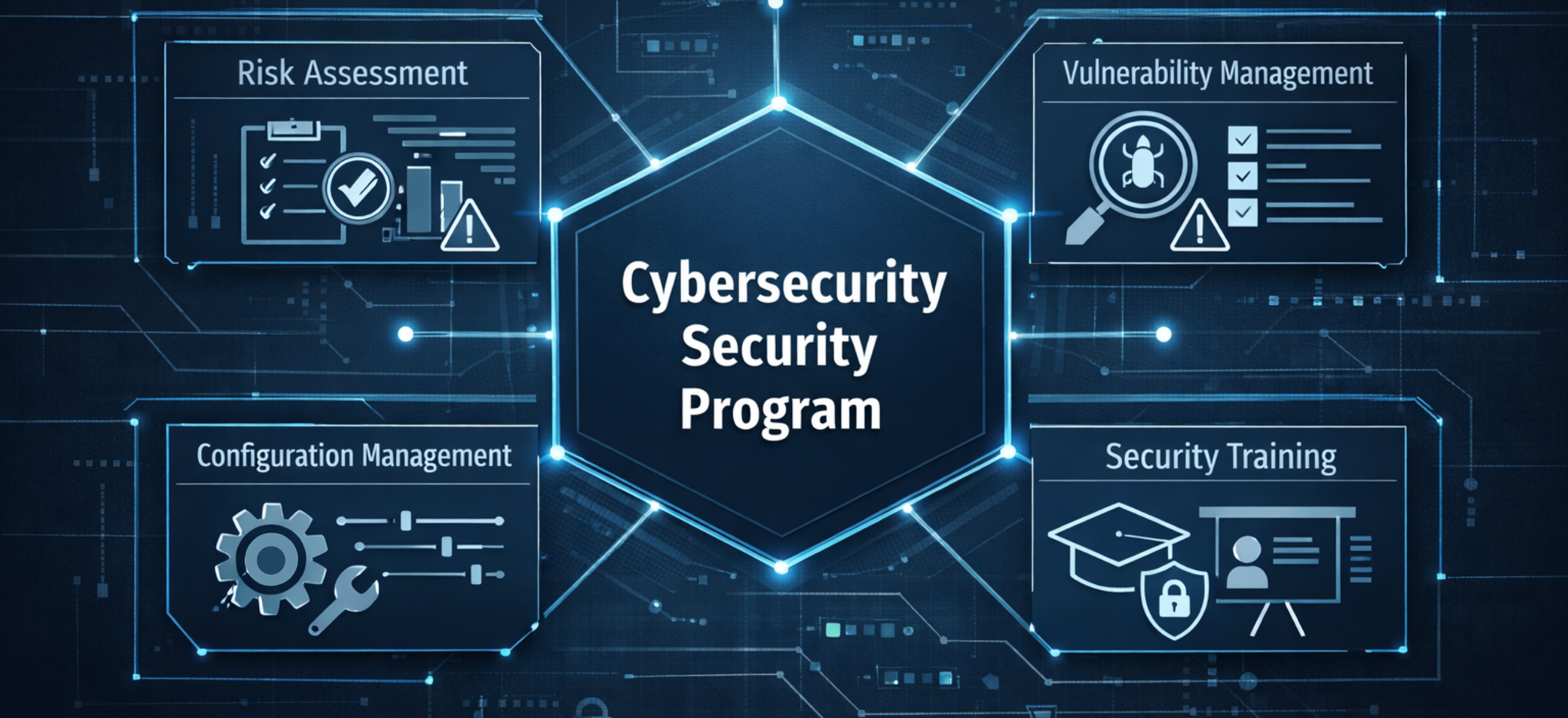
While implementations vary, mature security programs consistently include the following interconnected components:
Risk Assessment
Risk assessment establishes context. It identifies assets, threat vectors, vulnerabilities, and potential business impact. Without this step, security teams operate blindly, applying controls uniformly rather than proportionally.
A well-executed risk assessment enables leadership to make informed decisions about where to accept risk, where to mitigate it, and where additional investment is justified.
Vulnerability Management
Vulnerability management operationalizes risk on a technical level. It moves beyond simple scanning to include validation, prioritization, remediation, and verification.
Organizations with immature programs often collect vulnerability data but fail to act on it effectively. Mature programs integrate vulnerability management into change management and patching workflows, ensuring findings translate into measurable risk reduction.
Configuration Management
Secure configuration management is one of the most underappreciated security disciplines. Misconfigurations remain a leading cause of breaches, particularly in cloud and hybrid environments.
A strong configuration management process defines secure baselines, continuously measures drift, and enforces consistency across systems. This is where security becomes repeatable and scalable, rather than dependent on individual administrator expertise.
Security Awareness and Training
Technology cannot compensate for untrained users. Security awareness training is not about compliance checkboxes or annual videos—it is about changing behavior.
Effective programs tailor training to real-world threats, reinforce it regularly, and measure outcomes. When users understand their role in security, they become an extension of the security team rather than an uncontrolled risk.
Governance: The Glue That Holds the Program Together
What separates a collection of controls from a true security program is governance. Governance defines ownership, accountability, metrics, and continuous improvement.
This includes:
- Clearly defined roles and responsibilities
- Policies that reflect actual operational practices
- Metrics that leadership can use to track risk over time
Without governance, even well-implemented controls degrade. With it, security becomes a managed business function rather than an ad hoc technical effort.
Security Is a Continuous Process, Not a Destination
Threats evolve, environments change, and businesses grow. A security program must be designed to adapt accordingly. This is why static, one-time security initiatives consistently fail.
Organizations that succeed treat their security program as a living system—one that is regularly reassessed, tested, and refined. This mindset shift is critical, particularly for SMBs that may not have dedicated security leadership but still face the same threat landscape as larger enterprises.
Looking Ahead
This post serves as a high-level blueprint for what a cybersecurity program should encompass, how it’s structured, why it matters, and how its components work together to reduce organizational risk. In the next blog in this series, we’ll take a deeper technical look at risk assessments: how they should be conducted, what decision-makers should expect from them, and how to use their results to drive meaningful security improvements.
If you want to self-assess your current cybersecurity posture, we have a free step-by-step guide that you can access here. Designed by cybersecurity experts, this checklist gives you a clear picture of where your defenses stand and what to tackle next.
Author Bio
Anthony Siravo is a Solution Engineer with over 15 years of experience in cybersecurity, working with organizations across a wide range of industries and environments. With Network+, Security+, and PenTest+ certifications, Anthony specializes in translating complex security concepts into practical, risk-driven programs that align with real-world business operations. Since entering the field in 2008, Anthony has focused on helping IT leaders move beyond reactive security and toward sustainable, measurable risk management.
Frequently Asked Questions (FAQs) About Developing a Cybersecurity Program
What is the goal of a cybersecurity program?
The primary goal is to reduce business risk by systematically identifying threats, prioritizing remediation efforts, and aligning security controls with business impact rather than technical severity alone.
Do small and mid-sized businesses need a formal security program?
Yes. SMBs face the same threat actors as large enterprises but often with fewer resources. A right-sized security program provides structure and prioritization without unnecessary complexity.
How is a security program different from compliance?
Compliance focuses on meeting specific requirements at a point in time. A security program focuses on continuous risk management. Mature organizations use compliance frameworks to support—not define—their security program.